
When a neighbor's junk ends up on your property
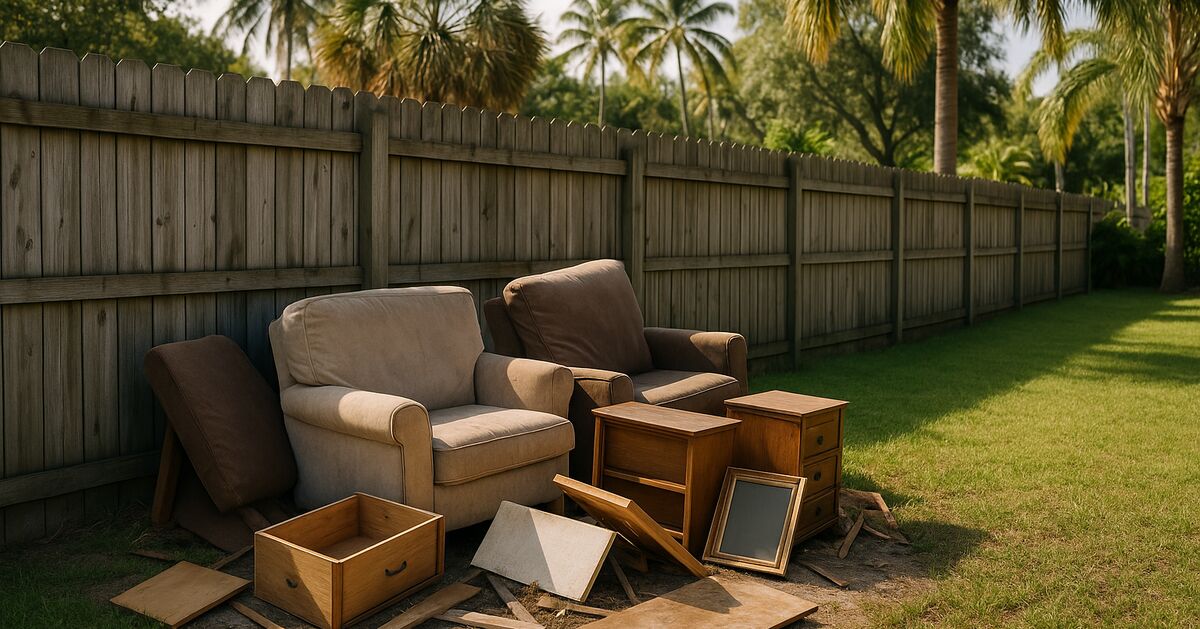
Your neighbor's rusting refrigerator is sitting six feet inside your property line, and they insist it's on their side. It isn't. That gap between "what someone claims" and "what the survey says" is where a surprising number of Sarasota-area property disputes get stuck, sometimes for months. This guide walks you through the practical steps to resolve it without blowing up the relationship, spending a fortune on attorneys, or waiting for a county inspector who may never come.
Why this happens more often than you'd expect
Florida's warm climate and older neighborhoods create a perfect recipe for boundary confusion. Yards in Sarasota, North Port, Nokomis, and Englewood were often platted decades ago, and fence lines shift over time as posts rot and get re-driven "close enough." After a hurricane or tropical storm, debris piles up wherever the wind drops it, and nobody is thinking about property lines in the middle of cleanup. In other situations, a neighbor simply dumps or stores items against a shared fence, gradually creeping over the line. By the time you notice, there's a small mountain of junk that everyone pretends belongs to someone else.
The problem is not just aesthetic. Piles of debris on your property may affect your homeowner's insurance coverage, create tripping hazards, attract pests, and complicate a future sale or refinance when a survey is ordered.
Step one: confirm where your property line actually is
Before you say a word to your neighbor, know your ground. Feelings and fence lines are not legal facts. Property boundaries in Florida are established by recorded plats and surveys, not by where someone happened to plant a hedge.
Pull your deed and look for references to a survey or plat. Most Sarasota County property records are searchable online through the Sarasota County Property Appraiser's website. If you can locate the original survey drawing, look for iron pins or concrete monuments in the corners of your lot. These are the legal markers.
If you cannot find the pins (they get buried, moved, or overgrown), hire a licensed Florida land surveyor to re-stake the corners. A boundary survey in this region typically costs a few hundred dollars, though prices vary, and gives you a document showing where your line falls. This single step prevents a week of heated guessing.
Once you have the survey in hand and the junk is definitively on your side of the line, you are on solid footing for every step that follows.
Step two: talk to the neighbor first
This sounds obvious, and yet it's the step people skip most often, usually because the conversation feels uncomfortable. A calm, factual conversation resolves a large portion of these disputes before they escalate.
Bring the survey (or a sketch with measurements from the pin to the junk). Show, don't argue. Something like: "Hey, I had a surveyor come out and it turns out this pile is actually about four feet inside my lot. I'd like to get it cleared up in the next couple of weeks. Are you able to handle it, or should I?" That framing puts the ball in their court while making clear you intend to act.
Give a written follow-up (an email or a dated letter) documenting what was discussed and the timeline you agreed on. This matters if you later need to escalate.
Step three: understand what Florida law says about encroachment
Florida does not have a single statute that says "a neighbor's junk on your land must be removed within X days." Instead, the framework comes from a few different legal areas:
Property encroachment and trespass. Under Florida common law, placing or leaving personal property on someone else's land without permission is a trespass. You generally cannot simply haul away a neighbor's belongings yourself without first giving reasonable notice, because doing so could expose you to a claim for conversion (destruction of property). The notice requirement is not spelled out in a single statute; it comes from case law and practical reasonableness standards.
Florida nuisance law. If the encroaching junk creates a health or safety hazard, it may rise to the level of a private or public nuisance under Florida Statutes Chapter 823. This gives you grounds to demand abatement and, if that fails, to pursue it through civil court.
Local codes. Sarasota County Code and the codes of incorporated cities like Venice, North Port, and Englewood all include property maintenance and nuisance abatement provisions. These are enforced by code enforcement officers who can cite the property owner (your neighbor) for allowing junk, debris, or unsanitary conditions on their property. If the junk started on their land and slid over, they are typically still the responsible party.
None of this is legal advice. An attorney familiar with Sarasota County property law can advise you on your specific situation, especially if there is significant value involved or the neighbor is hostile.
Step four: file a code enforcement complaint if needed
If the neighbor does not act after a reasonable written notice (two weeks is a common benchmark), your next step is usually a code enforcement complaint rather than a lawsuit. It costs nothing, and it gets a county official involved who can compel action with fines.
For unincorporated Sarasota County, contact Sarasota County Code Enforcement. For properties inside city limits in Venice or North Port, contact the respective city's code compliance department. For Englewood, which straddles the Sarasota/Charlotte county line, confirm which jurisdiction governs the specific parcel before you file.
When you file, be specific: include photos with timestamps, the survey or measurements showing the junk is on your property, dates of your prior written notice, and the neighbor's non-response. A well-documented complaint moves faster than a vague one.
Code enforcement typically issues a notice of violation to the property owner of record, sets a compliance deadline, and follows up with re-inspection. If the neighbor still does not act, fines accrue daily. The threat of daily fines motivates action far more reliably than a neighbor's goodwill.
Step five: if the neighbor clears it, great. If not, your legal removal options
At some point, you may have the legal right to remove encroaching items from your property. The two most common paths:
Self-help after proper notice. In some circumstances, after documented written notice and a reasonable time for the neighbor to act, Florida courts have recognized the right of a landowner to remove encroaching items at the neighbor's expense. This is fact-specific and carries risk. Do not do this without either the neighbor's written consent or an attorney's guidance.
Court order. A civil complaint for trespass or nuisance can result in a court order requiring removal. Small claims court in Sarasota County handles cases up to a set dollar limit, which typically covers junk or debris removal costs; confirm the current limit locally. If you end up removing the items and want to recover the cost, a small claims filing is your vehicle.
County abatement. In nuisance cases, the county can sometimes perform the removal itself and place a lien on the responsible property. This is more common with public health hazards than ordinary junk piles, but it is an option worth asking code enforcement about.
What a junk removal company can and cannot do for you
Here is where we can speak from direct experience. A professional junk hauler can remove items efficiently and legally once you have the right to do so. What we cannot do is make legal determinations for you, adjudicate whose property a pile is on, or haul away someone else's belongings based only on your say-so.
If you have the neighbor's written consent to remove their items on your property, we can load and haul everything in a single visit. If a court order directs that items be removed from your land, we can execute that removal. If the neighbor has abandoned the property entirely (a situation more common in North Port and parts of Englewood after financial distress), the path is different and is worth reviewing alongside our post on what Sarasota junk haulers can and cannot touch when there's an active estate.
In situations where you simply want the quote and timeline nailed down before the legal dust settles, we are glad to give you a free estimate so you know exactly what you're looking at cost-wise when the green light comes. Visit our contact page to get that scheduled.
Common situations we see on the ground
Storm debris that blew over the fence. After a significant storm in Sarasota or Venice, fencing, lumber, patio furniture, and roofing materials end up everywhere. Generally, the homeowner on whose property storm debris lands is responsible for coordinating its removal, though recovery programs and county pickup schedules may apply; check FEMA and county guidance for specifics. Check with Sarasota County's solid waste division after any declared disaster event for curbside pickup rules before hauling things yourself.
Old vehicles sitting on the property line. Vehicle encroachment is a particularly tangled subset because Florida has specific abandoned vehicle statutes (Florida Statutes Chapter 705) that govern how a vehicle may be reported and removed. We have covered the vehicle-specific angle in depth in our post on vehicle-filled property in North Port when the cars aren't yours to remove.
A neighbor who has passed away. Sometimes the "neighbor" is an estate, and there is no living person making decisions about the junk that has crept onto your lot. In that case, the estate's personal representative is the party to contact. If probate is underway, the timeline for getting action from the estate can be slow. Our post on cleanout timing after a Sarasota probate filing explains why things move at the pace they do.
Rental properties with absentee landlords. If your neighbor is a tenant and the landlord is somewhere out of state, the landlord is ultimately the responsible party under Florida law. Code enforcement can track down the property owner of record and serve them with a notice of violation even when they live far away.
Protecting yourself going forward
Once the situation is resolved, a few steps reduce the chance of a repeat:
- Get a new survey pinned and flagged. Physical markers make boundary disputes far less likely because there is nothing to argue about.
- Install a fence on your side of the line, set back a few inches. This keeps your fence clearly on your land and creates a visible, physical boundary.
- Document everything by date. If the situation recurs, a folder of dated photos and letters shortens every future legal proceeding.
- Know your local code. Sarasota County, the City of Venice, and North Port all publish their property maintenance codes online. A quick read tells you exactly what conditions are actionable and what the complaint process looks like.
For a full picture of what our crew handles across the region, browse our junk hauling and estate cleanout services or check out our service areas page to confirm we cover your corner of Sarasota County.
The bottom line
A neighbor's junk on your property is a genuine legal and practical problem, not just an eyesore. The resolution path is often similar: confirm the line with a survey, document everything in writing, ask politely and formally, escalate to code enforcement if needed, and understand your legal options before taking any physical action. Skipping steps tends to create new problems rather than solving the original one.
When you do get to the removal stage, a reputable local hauler can make that part of the process fast and straightforward. We serve homeowners throughout Sarasota, Venice, Nokomis, Englewood, Osprey, North Port, Siesta Key, and Longboat Key, and we are used to situations where the backstory is complicated even when the physical work is simple. Check our FAQ page for answers to common questions about what we haul, how pricing works, and what to expect on the day of service.
Sources & further reading
- Florida Statutes Chapter 823 - Public Nuisances (Florida Legislature)
- Florida Statutes Chapter 705 - Lost or Abandoned Property (Florida Legislature)
- Sarasota County Property Appraiser - Property Search (Sarasota County Property Appraiser)
- Florida Department of Business and Professional Regulation - Land Surveyors (Florida DBPR)
- Federal Emergency Management Agency (named in this article) (Federal Emergency Management Agency)
Claim-by-claim audit (8 checked)
- “Piles of debris on your property may affect your homeowner's insurance coverage, create tripping hazards, attract pests, and complicate a future sale or refinance when a survey is …” (rewritten to what the article can stand behind)
- “A boundary survey in this region typically costs a few hundred dollars, though prices vary, and gives you a document showing where your line falls.” (rewritten to what the article can stand behind)
- “If the encroaching junk creates a health or safety hazard, it may rise to the level of a private or public nuisance under Florida Statutes Chapter 823.” (cited → flsenate.gov)
- “Florida has specific abandoned vehicle statutes (Florida Statutes Chapter 705) that govern how a vehicle may be reported and removed.” (cited → flsenate.gov)
- “Generally, the homeowner on whose property storm debris lands is responsible for coordinating its removal, though recovery programs and county pickup schedules may apply; check FEM…” (rewritten to what the article can stand behind)
- “Small claims court in Sarasota County handles cases up to a set dollar limit, which typically covers junk or debris removal costs; confirm the current limit locally.” (rewritten to what the article can stand behind)
- “If the neighbor does not act after a reasonable written notice (two weeks is a common benchmark), your next step is usually a code enforcement complaint rather than a lawsuit.” (reasoning shown in the article)
- “Code enforcement typically issues a notice of violation to the property owner of record, sets a compliance deadline, and follows up with re-inspection.” (reasoning shown in the article)