
Eviction cleanout in Sarasota County: what's legal
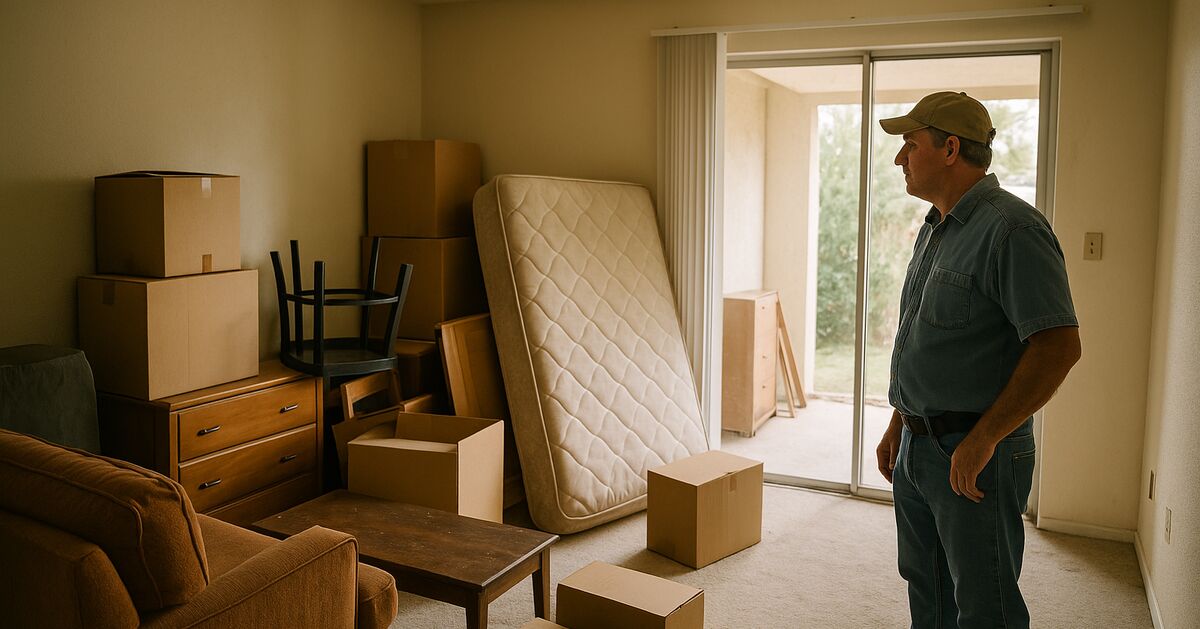
Your eviction finally went through, the sheriff showed up, and the tenant is gone. Now you're standing in a rental unit surrounded by mattresses, broken furniture, bags of clothing, and a refrigerator full of food. Your first instinct is to back a truck up and clear everything out this afternoon. Slow down. Florida law gives tenants specific rights over the belongings they left behind, and if you skip the required steps, you can end up on the wrong end of a civil lawsuit even after you've won the eviction.
This guide walks Sarasota County landlords through exactly what the law requires, what you can legally dispose of right away, what has to be stored or noticed, and how to work with a professional junk hauler once you've cleared the legal hurdles.
Why eviction cleanout is legally different from a standard vacancy cleanout
When a tenant moves out voluntarily, any property they leave behind is generally considered abandoned after a reasonable period. An eviction is different. The tenant didn't choose to leave on their own schedule. Florida Statutes Chapter 83, the Residential Landlord and Tenant Act, lays out a specific process landlords must follow before disposing of personal property left on the premises after a court-ordered eviction.
Skipping that process, even by a day, can expose you to liability for the full replacement value of whatever you threw out. Landlords who dispose of tenant property without following the statutory process risk being held liable for the value of items thrown out. The inconvenience of following the notice procedure is far smaller than the cost of defending a civil claim.
What Florida law actually requires: the written notice
Under Florida Statute 83.67 and the related provisions in Chapter 715 (which governs personal property left on premises), a landlord who has recovered possession of a rental unit must give the former tenant written notice before disposing of personal property left behind.
The notice must include:
- A description of the property left behind
- The address where the property is being stored
- A deadline for the tenant to claim it (at least 10 days if you plan to dispose of it, or at least 15 days if you plan to sell it at a public sale)
- A statement that the property will be disposed of or sold if not claimed by the deadline
The notice must be sent by first-class mail to the tenant's last known address and, if you know it, any other address the tenant provided. If the tenant responds and arranges to pick up the property within the deadline, you are required to make it available at a reasonable time. You may charge the tenant for the reasonable cost of storage before releasing the items.
Per the Florida Legislature's published text of Chapter 715, if the total value of the property is estimated at less than $500, you have a somewhat more streamlined path: you can dispose of it after giving the required notice and waiting out the deadline, without conducting a formal public sale.
What you can dispose of immediately after a Sarasota eviction
Not everything left in a rental requires the full notice-and-wait process. Florida law and common sense both allow you to immediately remove and discard items that are:
- Clearly trash or debris - empty food containers, garbage bags the tenant was clearly discarding, broken items with no resale or sentimental value, spoiled food from the refrigerator or pantry
- Health and safety hazards - materials that pose an immediate threat to the property or to neighbors, including mold-contaminated soft goods and pest-infested items (document everything with photos before removal)
- Items affixed to or part of the property - shelving the tenant installed without permission and left behind, makeshift curtain rods, items nailed to walls
Even for these categories, photograph everything before you touch it. A timestamped photo record is your best protection if a dispute arises later. Our post on how to document a hoarder house cleanout for insurance or legal purposes covers documentation best practices that apply equally well here.
The gray zone: items that look worthless but legally are not
A rusty bicycle, a pile of mismatched dishes, a beat-up couch. Your gut says this is junk. Florida law doesn't care what it looks like. If the tenant might want it back, and its estimated value pushes the total above $500, you have to follow the full notice procedure before disposing of it.
Items that landlords commonly misjudge:
- Electronics, even older ones, because resale value is not the same as replacement-cost value in a claim
- Children's toys and clothing, which can carry outsized sentimental value in a dispute
- Tools and work equipment, which can have high replacement costs
- Documents and paperwork, including prescription information, financial records, and ID documents (these are also sensitive from a privacy standpoint)
- Medications, which additionally fall under hazardous materials rules and cannot simply be thrown in the trash (per EPA guidance on pharmaceutical disposal)
- Anything in boxes or bags you haven't opened, because you genuinely cannot estimate the value of sealed containers
If you're unsure whether the total estimated value clears $500, treat it as if it does. The cost of storing items for 10 to 15 days is typically less than the cost of litigation.
Storing the property during the notice period
You don't have to keep the items inside the rental unit while you wait out the notice period. You can move them to a storage facility and charge the tenant reasonable storage costs before releasing the property. What you cannot do is hold the property hostage or refuse to return it once the tenant has complied with the notice terms.
If you're managing multiple rental properties across Sarasota County, Venice, North Port, or Englewood, keeping a relationship with a local junk hauler makes storage logistics much easier. A hauler can load items, stage them cleanly, and stand by to remove them the moment your legal window closes. See our full list of service areas to find out where we work.
After the deadline: what happens to unclaimed property
If the tenant doesn't respond to your notice within the required window, you are legally permitted to:
- Dispose of it if the estimated value is under $500
- Sell it at a public sale (with additional notice requirements) if the value is $500 or more, applying proceeds first to storage and removal costs and returning any surplus to the tenant or the state
For most residential eviction cleanouts in the Sarasota area, the practical reality is that the items left behind are low-value, and after the 10-day window closes, the landlord can call a hauler and clear the unit. That's the moment to move quickly, because every day the unit sits empty costs you rental income.
Our junk hauling and estate cleanout services are set up for exactly this scenario. We can typically schedule a same-day or next-day appointment once you've confirmed your legal window has closed, load everything that remains, and have the unit ready for your next tenant within a few hours depending on volume.
Special situations that complicate the cleanout
The tenant left a vehicle
A car, truck, or trailer on the property is not personal property in the ordinary sense under Chapter 715. Vehicles have titles, lien possibilities, and their own abandoned-vehicle statutes. In Sarasota County, an abandoned vehicle on private property generally requires notice to the Florida Department of Highway Safety and Motor Vehicles before removal and must be towed by a licensed wrecker. Do not call a standard junk hauler to remove a vehicle without confirming the proper procedure. Our related post on vehicle-filled property in North Port when the cars aren't yours to remove goes deeper on this issue.
The tenant left firearms
Firearms require careful handling regardless of context. Do not move, store, or dispose of firearms without contacting Sarasota County Sheriff's Office first. A found firearm with an unknown history may be stolen property, and improper handling creates serious legal exposure.
Signs of hoarding conditions
Some eviction cleanouts reveal that the unit was occupied under hoarding conditions, with years of accumulated material, potential structural concerns, pest infestation, or biohazard materials. In these cases, a standard cleanout crew is not always appropriate. Read about what a professional crew actually finds and how they handle it in our post on animal hoarding aftermath and what a Sarasota cleanout crew encounters.
The tenant is deceased
If your eviction was filed and the tenant passed away before or during the process, the legal situation changes entirely. The tenant's belongings may now be part of an estate, and the personal representative of that estate has rights over the property. Contact a Florida probate attorney before touching anything. Our post on cleanout timing after a Sarasota probate filing covers the interaction between estate law and property cleanout.
What a professional junk hauler can and cannot do for you
A junk hauler is not a legal advisor. When you hire us for an eviction cleanout in Sarasota, Venice, North Port, Nokomis, or anywhere else we serve, our job is to remove what you've legally determined can be removed, load it efficiently, and make sure items that can be donated or recycled don't go straight to the landfill.
What we can do:
- Remove furniture, appliances, mattresses, boxes, clothing, and general household debris once your legal window has closed
- Separate out items that are donation-eligible and drop them at appropriate facilities
- Handle oversized or heavy items that would be dangerous to move without proper equipment
- Clean up the space so it's ready for a contractor or a new tenant
What we cannot do:
- Make legal determinations about what you're allowed to remove
- Handle vehicles, firearms, or certain hazardous materials (biohazard waste, bulk chemicals)
- Store tenant property on your behalf in a legally recognized way (use a licensed storage facility for that)
If you have questions about what falls into which category, our FAQ page covers common scenarios, and you're always welcome to contact us before booking so we can talk through the scope of the job.
A practical timeline for Sarasota County landlords
Here's a realistic sequence to keep you on the right side of the law and get your unit back quickly:
- Day 0 (writ executed, tenant removed): Photograph the entire unit before touching anything. Document every room, every item, every corner.
- Day 0-1: Immediately remove obvious trash, spoiled food, and health hazards. Document what you removed and why.
- Day 1: Inventory remaining personal property and estimate total value. Prepare and mail the written notice required under Florida Chapter 715.
- Days 1-10 (or 1-15 for sales): Store remaining property safely. Respond promptly if the tenant contacts you to arrange pickup.
- Day 11 (or 16): If no response, contact a junk hauler to schedule the full cleanout. Confirm your legal window in writing before the crew arrives.
- Day 12-13 (typical): Full cleanout completed, unit ready for turnover.
Following this sequence won't guarantee zero disputes, but it creates a clear paper trail showing you acted in good faith and followed Florida law. That paper trail is worth more than the few days you might save by moving faster than the statute allows.
Local resources for Sarasota County landlords
For questions about Florida landlord-tenant law, the Florida Bar's lawyer referral service and Florida Legal Services both provide guidance. The Sarasota County Property Appraiser's office can help with property documentation questions. For specific notice requirements, refer directly to Florida Statutes Chapter 83 and Chapter 715, both of which are published in full on the Florida Legislature's website.
For the physical work of clearing the unit once you've done everything the law requires, we're ready. Explore everything we offer on our services page, or reach out directly to talk through your specific situation. We work throughout Sarasota County and know the local regulations well enough to ask the right questions before we load the first item.
Sources & further reading
- Florida Residential Landlord and Tenant Act, Chapter 83 (Florida Legislature)
- Florida Statutes Chapter 715: Personal Property on Premises of Rental Housing (Florida Legislature)
- Florida Department of Highway Safety and Motor Vehicles: Abandoned Vehicles (Florida Department of Highway Safety and Motor Vehicles)
- Sarasota County Sheriff's Office (Sarasota County Sheriff's Office)
- U.S. Environmental Protection Agency (named in this article) (U.S. Environmental Protection Agency)
Claim-by-claim audit (7 checked)
- “Landlords who dispose of tenant property without following the statutory process risk being held liable for the value of items thrown out.” (rewritten to what the article can stand behind)
- “Under Florida Statute 83.67 and the related provisions in Chapter 715 (which governs personal property left on premises), a landlord who has recovered possession of a rental unit m…” (cited → flsenate.gov)
- “Per the Florida Legislature's published text of Chapter 715, if the total value of the property is estimated at less than $500, you have a somewhat more streamlined path: you can d…” (cited → flsenate.gov)
- “Medications, which additionally fall under hazardous materials rules and cannot simply be thrown in the trash (per EPA guidance on pharmaceutical disposal)” (cited → epa.gov)
- “In Sarasota County, an abandoned vehicle on private property generally requires notice to the Florida Department of Highway Safety and Motor Vehicles before removal and must be tow…” (cited → flhsmv.gov)
- “Do not move, store, or dispose of firearms without contacting Sarasota County Sheriff's Office first.” (cited → sarasotasheriff.org)
- “A found firearm with an unknown history may be stolen property, and improper handling creates serious legal exposure.” (reasoning shown in the article)