
Sarasota garage cleanout when everything is mixed: a
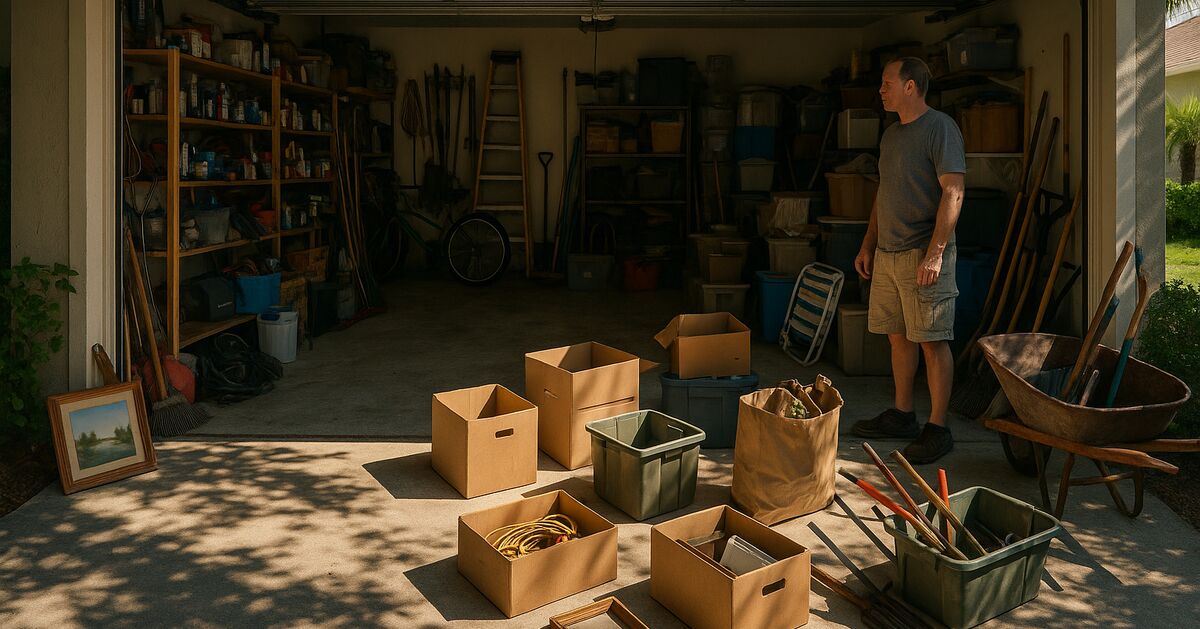
The garage door goes up, the Florida heat rolls in, and you stare at fifteen years of accumulated stuff with no idea where to even set your feet. That moment of paralysis is the real reason most Sarasota garage cleanouts never happen - not laziness, but genuine confusion about what to do with a space where a bag of fertilizer sits next to your dad's old Craftsman set, a broken push mower, and three boxes marked "misc."
This guide is for exactly that situation. We'll walk through how to sort a fully mixed garage, explain why each category needs its own path, and cover the specific quirks of doing this in Sarasota County so you don't end up with a pile of paint cans and nowhere legal to put them.
Why the "mixed garage" is harder than a regular cleanout
A bedroom or living room cleanout tends to be mostly furniture and soft goods - things that are easy to assess and easy to move. A garage is different because it holds items from almost every category that exists in a cleanout:
- Keepers: tools, sports equipment, seasonal decorations, garden supplies
- Donations: furniture, working small appliances, serviceable tools
- Hazardous materials: paint, solvents, pesticides, pool chemicals, motor oil, batteries
- Junk for hauling: broken equipment, rusted metal, old lumber, worn-out furniture
- Electronics: old TVs, computers, power tools that no longer work
- Unknown: boxes that haven't been opened since the last move
When these categories are all mixed together in the same physical space, the mental load of processing each item is enormous. Every single object requires a decision from a different mental "drawer." That's why even motivated people often shut the garage door and walk away.
The fix is to stop trying to make decisions and start sorting into physical zones first. Decisions come later.
Step 1: Stage your sorting zones before you touch anything
Before you move a single item, designate four physical zones either in the driveway or along the walls of the garage. Use painter's tape, cardboard signs, or colored tarps if you have them. The zones are:
- Keep (going back into the garage or house)
- Donate / Sell (items in working condition that someone else can use)
- Hazmat (anything with a chemical warning label or that you wouldn't put in a dumpster)
- Haul away (broken, rusted, waterlogged, expired, or just unwanted junk)
You are not making final decisions yet. You are just relocating items from "random pile" to "labeled zone." That shift alone cuts decision fatigue in half. Once the zones start filling up, patterns emerge and the final calls become easier.
One practical tip for a Sarasota garage: start early in the morning. By 10 a.m. in the summer, a garage without air conditioning is genuinely punishing. If your cleanout is going to take a full day, break it into two mornings rather than one brutal session.
Step 2: Handle the hazardous materials first - this is non-negotiable
This is the category most people push to the end, which is a mistake. Hazmat items need to leave through a completely different channel than everything else, and knowing which items are in that category upfront protects you from accidentally loading them into a truck with regular junk.
Common hazardous materials found in a Sarasota garage:
- Latex and oil-based paint (even partially used cans)
- Pool chemicals - extremely common here given that almost every home has a pool
- Pesticides and herbicides (lawn care products, ant killers, sprays)
- Motor oil, transmission fluid, brake fluid
- Gasoline or gas/oil mixes in containers
- Propane cylinders
- Rechargeable batteries and lithium batteries
- Fluorescent light bulbs
- Mercury thermostats or thermometers
Sarasota County Solid Waste accepts household hazardous waste (HHW) at designated drop-off events and at the Bee Ridge Transfer Station. Check the county's current schedule before your cleanout day, because drop-off hours are not daily. Motor oil is often accepted at auto parts retailers year-round, which can simplify that piece.
Pool chemicals deserve extra respect. Never mix different pool chemical containers or expose them to moisture. Keep them in their original containers and transport them separately from everything else. If you are unsure what you have, bring in a professional rather than guessing.
Junk haulers, including our team, cannot legally accept hazardous materials in a standard haul. This is not a policy quirk - it is a regulatory requirement. Knowing which items are hazmat before the hauler arrives saves everyone time and keeps the project moving smoothly. Our FAQ page covers this in more detail if you want to know exactly what falls into that category locally.
Step 3: Sort tools with real intention
Tools are the category that derails the most garage cleanouts because there is always an emotional current running through them. Your grandfather's socket set. A router you bought for a project you never finished. Three levels when you only need one.
Here is a practical framework:
Keep if:
- You have used it in the past two years
- You would genuinely buy it again tomorrow
- It is in working condition and has no realistic replacement in your current tool collection
Donate or sell if:
- It is in good working condition but you have a duplicate
- It is a specialty tool for a project that is now clearly never happening
- It is serviceable but you have upgraded
Haul away if:
- It is broken and repair is not realistic
- It is corroded, missing parts, or has a dead motor
- The cord is frayed or it poses a safety risk
Working tools have real donation value in this area. Habitat for Humanity ReStores in Sarasota accept tools, and organizations that support vocational training programs sometimes welcome hand tools. Don't send working tools to the junk pile out of convenience.
For the truly heavy or awkward stuff, like a chest freezer that died in the garage, an old riding mower, or a cast-iron table saw, those need to be planned for separately. Our post on oversized items and removal options during a Sarasota cleanout goes into detail on those specific situations.
Step 4: Build your donation pile carefully
The Sarasota area has solid options for donation pickups and drop-offs, but not everything in your garage qualifies. Donation centers have gotten stricter in recent years, and showing up with items they cannot accept wastes your time and theirs.
Typically accepted:
- Clean, functional furniture with no major damage or mold
- Working small appliances
- Hand tools and power tools in working order
- Sporting goods (bikes, kayak paddles, weights)
- Garden tools in usable condition
- Shelving units that are clean and fully assembled
Typically not accepted:
- Anything with mold or mildew (a real concern in Florida humidity)
- Mattresses
- Broken items, even if "fixable"
- Car seats
- Paint or chemicals (not a donation item under any circumstances)
For larger items, call ahead. The Goodwill in Sarasota, the Habitat ReStore, and various local thrift shops all have different policies. If you have a significant volume of donateable items, some organizations offer free pickup for large loads. Plan that pickup for after your sorting is done so you are not waiting on a truck while the rest of the project is paused.
Step 5: Plan the junk hauling load before the truck arrives
Once hazmat, keepers, and donations are separated, what remains is your junk pile, and this is where a professional hauler adds the most value. A good junk hauling and cleanout service will load everything from that pile, sweep out the space, and handle sorting at the facility to divert as much as possible from the landfill.
To get an accurate quote and avoid surprises on appointment day:
- Walk the pile and note any items that are especially heavy (full metal shelving, concrete blocks, old cast-iron equipment)
- Note any items that might need special handling (propane tanks, even empty ones, typically need a separate process)
- Have your hazmat pile clearly separated and labeled so there is no confusion at the door
- Measure any oversized items if you are not sure whether a standard crew can handle them
If you are in Sarasota, Venice, North Port, Englewood, or anywhere else in the county, local haulers are going to be faster and more familiar with county disposal requirements than a national franchise that sends a generic crew. For specifics on what our team covers, see our service area locations page.
What about electronics?
E-waste is its own category and it comes up in almost every garage cleanout. Old televisions (especially tube TVs), desktop computers, monitors, and dead power tools all count as electronics waste and should not go into a standard dumpster or junk load.
Best Buy accepts many electronics for recycling at their Sarasota store. Sarasota County also holds periodic e-waste collection events. If you have a large volume, call ahead, because some drop-off sites have limits per household.
One thing to flag: if you have an old tube television (the big, heavy kind), do not assume any charity will take it. Very few do. It needs to go the e-waste route.
Common mistakes that slow down a garage cleanout
Trying to sell everything. Marketplace listings take time, energy, and follow-through. Reserve selling for truly valuable items and let the rest go to donation or hauling. A garage cleanout that takes three weekends instead of one because you are waiting on buyers to show up often ends with the owner exhausted and the garage still full.
Starting without a plan for each category. If you don't know where your paint cans are going before the cleanout starts, you will still have paint cans when you think you are done.
Underestimating weight. Garages hold dense stuff. Old tile, bagged concrete mix, dumbbells, engine parts. A single pickup truck load of garage junk often weighs more than it looks. If you are doing any self-hauling, be honest about what your vehicle and your body can handle.
Forgetting the ceiling and wall storage. Overhead racks and pegboards hold a surprising amount. Don't declare victory until you have gone through everything above your head, not just at floor level.
Leaving the hazmat pile for "later." Later becomes never. Handle it the same week as the rest of the cleanout while you still have momentum.
A note on garages in coastal communities
If your garage is on Siesta Key, Longboat Key, or anywhere close to the water, humidity and salt air create specific issues. Metal tools rust faster. Cardboard boxes break down and often harbor mold. Wooden furniture stored in these garages can have hidden moisture damage that makes it unsalvageable even when it looks fine from the outside.
Check the underside and backs of any wooden items before putting them in the donation pile. A chest of drawers that smells musty is not going to be accepted anywhere and is going to get rejected on pickup day. It is better to send it to the haul pile from the start than to waste a trip.
Similarly, if paint cans have been sitting in a coastal garage for years, check the lids carefully. Cans that have been exposed to humidity may have failed seals. Transport them upright and use extra caution.
For homeowners in North Port and Englewood, garages often hold more lawn and garden equipment given larger lots. Factor that in when estimating volume, especially if there is old equipment that no longer runs.
Putting it all together: a realistic timeline
For a single-car garage that is fully packed, a realistic timeline looks like this:
- Day 1 (2 to 3 hours): Set up zones, sort everything into the four categories, set aside hazmat items
- Day 2 (1 to 2 hours): Transport hazmat to the county facility or a drop-off event, arrange donation pickup or drop-off
- Day 3: Professional junk hauler arrives, loads the haul pile, you sweep out the space
For a two-car garage that has become a storage room, double those estimates. If there is any overlap with a larger estate situation, our full range of cleanout services might be worth a conversation, because a combined approach is often more efficient than handling the garage alone.
If you have questions about a specific situation before booking, our contact page is the fastest way to get a real answer without a sales pitch. A quick description of what you have lets us give you a useful sense of what is involved before anyone drives out.
The garage cleanout you have been postponing for two years is genuinely more manageable than it looks from the doorway. It just needs a sorting system, a plan for each category, and the willingness to start on a cool morning before the sun gets high.