
Boats, jet skis, and trailers found during a Sarasota
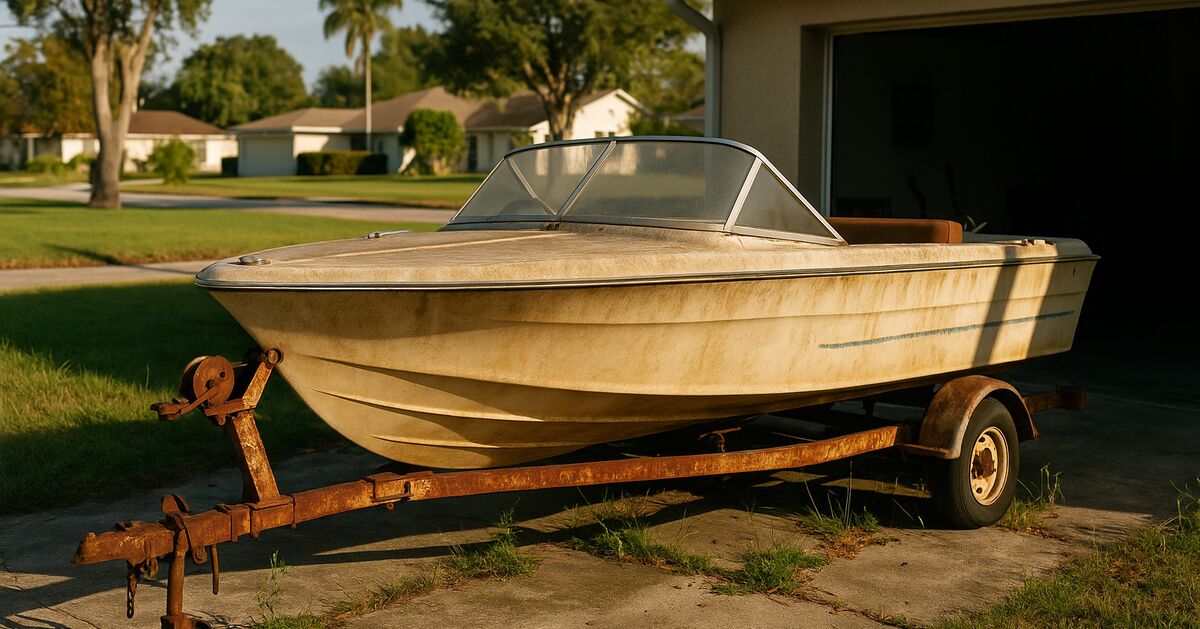
Nobody expects the cleanout to be simple, but finding a 20-foot center console rusting on a trailer behind the garage is a different kind of problem than finding old furniture. Watercraft and trailers carry titles, registration numbers, potential liens, and a whole set of rules that ordinary junk-removal logic does not apply to. If you are managing an estate in Sarasota County, clearing out a hoarder property in North Port, or helping a family member downsize in Venice, this guide will walk you through every realistic option, step by step.
Why watercraft and trailers are different from ordinary junk
Florida is a boating state, and Sarasota is at the heart of it. Intercoastal docks, Gulf access, and launch ramps from Englewood to Longboat Key mean that a surprising number of homes have a boat, a jet ski (technically a personal watercraft, or PWC), or at least a trailer parked on the property. During an estate cleanout or hoarder house cleanout, these items show up more often than people expect.
Here is why they require special handling:
- Title and registration. Florida requires boats with motors and all trailers to carry a certificate of title issued by the Florida Department of Highway Safety and Motor Vehicles (DHSMV). Selling or donating without a clear title is legally complicated and sometimes impossible.
- Potential liens. If the original owner financed the boat or trailer, a lien may still be attached. Transferring a vessel with an undisclosed lien can expose the new owner to serious problems.
- Environmental concerns. Fuel, oil, bilge water, and batteries inside a neglected boat require careful handling. You cannot simply toss these into a junk truck.
- Size and weight. A 22-foot boat on a trailer can weigh 5,000 pounds or more. Specialty equipment is often needed to move it safely.
- HOA and county rules. Many neighborhoods in Sarasota, Osprey, and Nokomis restrict how long a boat or trailer can sit in a driveway or side yard. If you are managing a property for a deceased person's estate, a citation can land in the estate's name.
Understanding these points upfront saves time, money, and legal headaches later.
Step one: figure out what you actually have
Before you decide what to do with the boat or trailer, spend thirty minutes gathering facts.
Find the Hull Identification Number (HIN). Every boat built after 1972 has a 12-character HIN etched or molded into the transom on the starboard (right) side. Personal watercraft have a HIN too, usually near the stern. Write it down.
Find the title and registration. Check the glove box of the tow vehicle, the home's filing cabinet, or any safe or lockbox. Florida boat registrations are renewed annually and display the vessel's registration number, which begins with "FL." The title is a separate document.
Check the trailer's VIN. Trailers over a certain weight also have a VIN plate, usually on the tongue or the frame rail. You will need this for title transfer.
Look for lien information. The title document will show whether a lienholder is listed. If the title is lost, you can request a title history from the DHSMV by submitting Form HSMV 72015 (Application for Vessel/Boat Title). There is a small fee, but the resulting record will tell you whether any lien is on file.
Assess the physical condition honestly. Is the engine present and does it turn over? Is the hull cracked, rotted, or delaminated? Is the trailer rusty or structurally sound? Condition dictates whether you are looking at a saleable asset or a disposal problem.
Step two: decide on the right path
Once you know what you have, there are four realistic options: sell it, donate it, surrender it to a title service, or arrange proper disposal. Each situation points to a different path.
Selling the boat or trailer
If the vessel is in reasonable condition and you have a clear title, selling is almost always the highest-value outcome. Florida has a robust used-boat market, and Sarasota's proximity to the Gulf makes demand strong for functional watercraft.
Private sale typically yields the best price but requires the most effort. You will need to advertise on platforms like Facebook Marketplace, Craigslist, or BoatTrader, answer questions, negotiate, and handle the DHSMV title transfer paperwork. The seller signs the back of the title, the buyer applies for a new title, and both parties should record the sale in writing.
Selling to a dealer or consignment lot moves the boat faster and shifts the paperwork burden. Dealers on US-41 and in the Venice area buy used boats outright, though you will accept less than private-sale value. Consignment lots display the vessel for a commission, which can take weeks or months.
Auction is worth considering when you want a defined end date. Several marine auction services operate in Florida, and the estate can set a reserve price.
One critical point: if the title is lost, get a duplicate before you try to sell. A buyer who cannot receive clear title will walk away, and rightfully so. A duplicate title application takes a few weeks to process through the DHSMV, so start this as early as possible if the cleanout is on a deadline.
Donating the vessel
Several nonprofit organizations in Florida accept boat donations. The Boat Angel program and similar charities accept watercraft in various conditions, sell them at auction, and provide a tax-deduction receipt to the donor. If the estate is itemizing deductions, this receipt can offset some of the estate's tax liability.
Donation works best when the boat has some functional value but selling it feels like too much work. The charity handles pickup, title transfer, and sale logistics. Your only job is to sign over the title and make sure the boat is accessible.
Check with any charity before committing: many programs require a minimum condition level, and some will not accept vessels that cannot be made seaworthy. Personal watercraft (jet skis and wave runners) are accepted by some programs but not all.
What to do when the title is missing and the boat is not worth much
This is the trickiest situation, and it is common. The boat has been sitting for years, the engine seized, the hull has stress cracks, and nobody can find the title. Here are your realistic options:
- Florida's abandoned or derelict vessel process. If the vessel is registered in someone else's name and cannot be traced to the estate owner, the Florida Fish and Wildlife Conservation Commission (FWC) has a process for handling derelict vessels. This path is slow and bureaucratic but may apply in some hoarder-property situations.
- Junking the hull. Some marine salvage yards in the region will accept a non-running boat for scrap or parts, sometimes at no cost and sometimes for a small fee. You will still need to provide whatever documentation you have and sign an affidavit of ownership.
- Florida title by affidavit (Form HSMV 82042). For older vessels of low value where the title is lost and the original owner is deceased, Florida allows a bonded title process. An attorney or title service can guide you through this. It takes time but results in a legitimate title you can use to sell or donate.
Do not try to push a titled vessel through the cleanout process as if it were a piece of furniture. The paperwork problem follows the vessel, and whoever ends up with it will eventually hit a wall.
Step three: handle the environmental items before anything moves
A neglected boat almost always contains materials that need careful disposal regardless of what happens to the hull itself.
- Fuel. Old gasoline degrades, gums up carburetors, and is classified as hazardous waste. Sarasota County's Household Hazardous Waste program accepts old fuel at the Central County Solid Waste Disposal Complex on Moccasin Wallow Road. Do not drain fuel onto the ground or into a drain.
- Oil. Used marine engine oil must be recycled. Many auto parts stores accept it for free.
- Batteries. Marine batteries contain lead and acid. They are accepted for recycling at most auto parts retailers.
- Fire extinguishers, flares, and EPIRBs. Expired marine flares are technically hazardous. The county's HHW program accepts them.
- Bilge water. If the bilge holds oily water, do not pump it onto the pavement or into a storm drain. Absorb it with oil-dry material and dispose of the saturated absorbent as hazardous waste.
Taking care of these items before the boat is towed protects you legally and is simply the right thing to do in a coastal community. For more on handling hazardous materials discovered during a cleanout, our post on medications, chemicals, and hazardous items found in a Sarasota estate cleanout covers the broader picture.
Step four: arrange the actual removal
Once the paperwork is sorted and the environmental items are handled, the physical removal can happen. A few things to know:
Boats on trailers can often be towed by a pickup truck if the trailer hitch receiver and the tongue weight rating match. If no tow vehicle is available, a marine transport company or a towing service can relocate the boat to a dealer, auction yard, or donation pickup point.
Boats without trailers need a specialty lift or a flatbed truck with the right equipment. Do not try to improvise this with a standard junk-hauling truck.
Personal watercraft are more manageable. A jet ski on a trailer can often be towed with a small SUV or crossover, and the stand-up models can be transported in a pickup bed with tie-downs.
Trailers only (no vessel attached) are straightforward. If the trailer has a clear title, it can be sold, donated, or scrapped like any other titled vehicle. Many scrap yards pay by the pound for steel trailers. If the title is missing, the same bonded-title process used for vessels applies.
If you are handling a larger cleanout of the rest of the property at the same time, coordinate the timing. A junk hauling crew can clear everything else from the property while the marine transport is arranged separately for the watercraft. Our team handles estate cleanouts and hoarder house cleanouts across Sarasota County and surrounding areas and can work alongside specialty marine movers when needed.
Common mistakes to avoid
Assuming the boat is worthless without checking. Older boats that look rough can still have working engines, quality electronics, or desirable features. Get at least one dealer appraisal before assuming disposal is the only option.
Trying to sell without a title. This creates risk for both parties and is not legally sound in Florida. Buyers will find out during their own due diligence, and the deal will fall apart.
Leaving the boat in the driveway while you figure it out. If the property is in a neighborhood with HOA enforcement or is being prepared for sale, a derelict boat can generate fines quickly. In some Sarasota County neighborhoods, code enforcement can issue a notice within days.
Forgetting about the trailer registration separately. In Florida, the trailer and the vessel each carry their own title. You need to handle both.
Draining the fuel or bilge water anywhere it should not go. This is an environmental violation. Coastal counties take it seriously, and the fines are not small.
When you are managing this from out of town
Many estates in Sarasota are managed by family members who live in other states. If you are flying in for a limited time to handle a property in Venice, Englewood, or Nokomis, the boat situation can feel overwhelming when added to everything else.
A few practical suggestions:
- Start the title search and any DHSMV requests before you arrive. Mail or scan whatever documents you can find from the estate records.
- Contact a local marine consignment dealer by phone before your trip. Many will come to the property for a free appraisal.
- Line up your junk-hauling crew for the rest of the property at the same time, so the two efforts can run in parallel. Our frequently asked questions page addresses what to expect when coordinating a multi-phase cleanout.
- If you simply cannot resolve the vessel's title situation during your trip, at minimum secure the boat physically (lock it, note its HIN), remove the valuables and the hazardous materials, and pick up the process remotely.
How we can help
A boat or jet ski is not something we toss in the truck like a broken recliner. Our role in this situation is to handle everything around the vessel while you handle the vessel itself, or to coordinate with a marine specialist when the situation calls for it.
If the estate also has the usual mix of furniture, tools, appliances, and general household junk, that is exactly what we are built for. Families managing properties in Sarasota, Venice, North Port, Englewood, and throughout the county rely on us to take the physical burden off their hands so they can focus on the legal and financial decisions.
You can learn more about everything we handle on our full services page, and if you are ready to talk through a specific cleanout, reach out to us directly. There is no obligation, and we are happy to walk you through what makes sense for your situation before any commitment is made.
The boat in the backyard does not have to be the thing that derails the whole cleanout. With a clear order of operations, the right professionals involved at the right moments, and a little patience on the paperwork, it is a solvable problem.