
Swimming pool full of junk during a Sarasota estate cleanout
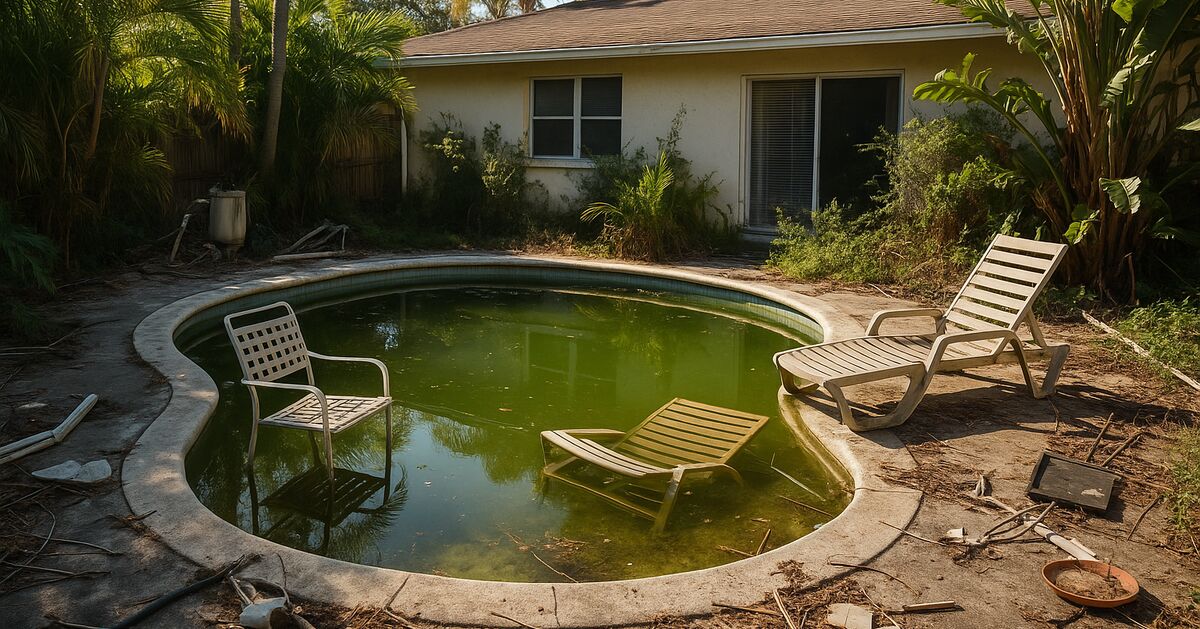
A swimming pool that has been ignored for months or years is not just an eyesore. It is a safety hazard, a mosquito breeding ground, and often the single most complicated item on a cleanout property's punch list. When families across Sarasota, Venice, North Port, and Englewood call us about estate or hoarder cleanouts, they sometimes mention a pool almost as an afterthought: "Oh, and the pool has stuff in it." What they mean, once we get out there, is that the pool is half-full of black water, has a broken pump sitting on the deck, a mountain of lawn furniture at the bottom, and maybe a floating collection of items that belong in a landfill. This post walks through exactly what you need to know, step by step.
Why pools become dumping grounds in the first place
Florida's outdoor lifestyle means pools see heavy use for years. When a homeowner ages, becomes ill, or simply stops being able to keep up, the pool is usually the first thing that gets ignored. A few missed weeks of chemical treatment turns the water green. Once the water goes green, people stop looking at it as a pool and start treating it as a catch-all space. Broken lawn furniture gets tossed in. Old pool equipment that stopped working sits on the deck until someone shoves it over the edge. Garden hoses, rusted tools, old patio umbrellas, even trash bags full of household junk get stacked along the perimeter and eventually topple in.
In hoarder situations specifically, the pool area becomes an overflow zone. We have arrived at properties in Nokomis and Osprey where the pool deck was stacked three feet high with items from the house, and the pool itself was more full of debris than water. The same creative storage instinct that fills every room of the house eventually extends outdoors.
Understanding the why helps you manage expectations: this is not a quick skim-and-vacuum job. It is a full removal project.
The three categories of pool junk you will encounter
Before you start pulling anything out, take a visual inventory. Pool junk generally falls into three buckets, and each one is handled differently.
1. Standard debris and household junk This is the most common category: broken furniture, pool floats, toys, garden equipment, tarps, and random household items. Most of this can be pulled out by hand or with a net, drained of water, and loaded onto a junk hauling truck. Our full range of junk hauling and cleanout services covers exactly this kind of material.
2. Abandoned pool equipment Old pool pumps, filter tanks, heaters, and chemical feeders are a category of their own. These are heavy, awkward, and sometimes contain residual chemicals (especially older chlorine or acid feeders). A pump sitting at the bottom of a pool that has been underwater for a year is waterlogged, corroded, and significantly heavier than it looks. Pool heaters that used natural gas can have fittings that need to be safely disconnected before anything is moved. Do not assume your junk hauling crew should also be your pool technician for this step. More on the sequencing below.
3. Hazardous materials This is the category that requires the most caution. Pool chemicals, even old or degraded ones, can be dangerous. A half-full jug of muriatic acid sitting in a pool shed or floating in the water needs to be handled separately from the rest of the cleanout. We covered the broader topic of hazardous materials in estate cleanouts in our post on medications, chemicals, and hazardous items found in a Sarasota estate cleanout, and pool chemicals fall squarely into that same territory. Never toss old pool chemicals into a standard dumpster or haul truck.
The right order of operations
Sequence matters enormously here. Skipping steps or trying to do everything at once leads to property damage, injury, and extra costs. Here is the order that actually works.
Step 1: Assess what's in the water before you touch anything
Put on rubber gloves and look before you reach. If the water is completely opaque (common with long-neglected Florida pools), use a pool pole to probe the bottom before sending anyone in or over the edge. You are checking for sharp metal, broken glass, and chemical containers. A rusted patio chair frame with jagged edges can do serious damage if someone reaches in blind.
Step 2: Pump out the standing water
You cannot retrieve most sunken items without draining the pool first, and you should not drain it yourself without knowing a few things. In Florida's high water table areas, including parts of Venice, Longboat Key, and coastal Sarasota, draining a pool completely can cause the shell to "pop" or shift upward due to hydrostatic pressure. This is especially common with older fiberglass pools. A pool contractor can install a hydrostatic relief valve or advise you on whether a partial drain is safer than a full one. If the pool is already significantly empty because the pump failed long ago, this risk is lower, but still worth confirming.
The water itself, especially water that has turned stagnant and anoxic, cannot simply be pumped into the street. Sarasota County has rules about where pool discharge water can go. Most of it needs to go to a sanitary sewer cleanout (with the utility company's permission) or be spread carefully onto a lawn in a way that does not cause runoff to storm drains or neighboring properties. Your pool contractor can handle this step properly.
Step 3: Remove debris and junk from the empty or near-empty pool
Once the water level is low enough, this is where a junk hauling crew earns their keep. Items are passed up out of the pool basin, sorted on the deck, and loaded accordingly. Some points to keep in mind:
- Waterlogged items are much heavier than they appear. A wooden pallet that has been submerged for months can weigh several hundred pounds.
- Everything that comes out of a neglected pool is covered in algae, mold, or sediment. Have a staging area on the deck where items can drip and be sorted without creating a slip hazard.
- Broken glass, ceramic, or tile fragments often collect at the pool's drain. Handle this area last and with heavy gloves.
- Metal items that have been submerged may have sharp rust edges that were not visible before the water was removed.
This is also the stage where you remove abandoned equipment that was sitting on the deck or the pool floor. Pumps, filter housings, and heaters get disconnected (gas and electrical lines should already be confirmed off at this point) and staged for separate disposal or, in some cases, sale as scrap metal.
Step 4: Clean the pool shell
Depending on what your plans are for the property, the pool shell may just need a pressure wash, or it may need professional resurfacing. For an estate being sold, a clean, structurally sound pool is a selling point. For a property where the pool will be demolished and filled, this step is unnecessary. Either way, the junk hauling work and the pool cleaning work are separate jobs with separate crews.
Step 5: Decide the pool's future
This is a decision that the estate's decision-makers need to make early in the process, because it affects every other step.
- Restore it: A working pool adds value in Sarasota's market. Get a pool contractor quote alongside your cleanout quote so you know both numbers before committing.
- Fill it in: Filling a pool is legal in Florida and increasingly common for older properties where ongoing maintenance is a burden. A licensed contractor is required. The fill must be done properly (perforated shell, clean fill material, proper compaction) or the ground can sink unevenly over time.
- Leave it drained: This is almost never the right answer. An empty pool is a liability, a magnet for trespassers, and a code enforcement risk. Many Florida municipalities, including those served by Sarasota County, have rules about abandoned pools.
If you're not sure what applies in your area, check with Sarasota County Code Enforcement or contact a local pool contractor for guidance. Our FAQ page also has answers to common questions about what we can and cannot handle during a cleanout.
What a junk hauling crew can and cannot do at the pool
Being honest about scope saves everyone time. Here is what a professional junk hauling team, like ours, handles at a pool during an estate or hoarder cleanout:
We can handle:
- All debris, furniture, toys, and household junk from the pool deck and pool basin
- Abandoned non-operational pool equipment (pumps, filters, heaters already disconnected)
- Trash bags, tarps, and accumulated clutter from around the pool area
- Pool accessories: nets, poles, brushes, floats, old chemicals in sealed containers (staged for proper disposal)
- Full load-and-haul service, with items sorted for donation, recycling, or disposal as appropriate
We cannot handle:
- Pumping out pool water (that is a pool contractor or water pumping service)
- Disconnecting gas or electrical lines to equipment
- Disposing of liquid pool chemicals (those need a hazardous waste handler)
- Structural pool repairs, crack assessment, or resurfacing
Knowing this boundary lets you line up the right contractors in the right order. If you call us first, we will tell you honestly what needs to happen before we can work safely and what can happen after.
Timing and the Sarasota estate cleanout calendar
One thing that catches families off guard is how a pool complication extends the cleanout timeline. In a typical estate cleanout with no pool issues, we can often clear a property in one to two days. Add a neglected pool with debris, and you are looking at scheduling a pool contractor first, waiting for the water to be pumped (which can take a day on its own for a large pool), then bringing in the junk crew, then possibly a pool cleaner or restoration crew after that.
In high season (roughly November through April), Sarasota-area pool contractors can be booked out two to three weeks. If you are working against a real estate closing date or a lease start date on a rental property in Siesta Key or Longboat Key, build that lead time into your planning. The same applies across the mainland: families handling estates in North Port or Englewood often underestimate how booked local contractors get during the winter months.
Start making calls as soon as you know the pool is a problem. Do not wait until the house is cleared to think about the pool.
Common mistakes families make with pool junk
We have seen the same mistakes come up repeatedly, and they are easy to avoid once you know about them.
- Trying to DIY the water pumping: Renting a submersible pump from a hardware store and running the hose into the street is tempting and usually a code violation. It also risks damaging the pool shell if the water table is high.
- Assuming the junk crew will handle everything: A junk hauling team is not a pool service. Calling one company and expecting them to do the work of three is a setup for frustration.
- Ignoring pool chemicals: Old oxidizers, algaecides, and pH adjusters sitting in a pool shed or floating in the water are not regular trash. Bag them separately, label them, and tell your junk crew what they are. Mixing unknown chemicals in a haul truck is dangerous.
- Underestimating weight: A waterlogged sofa at the bottom of a pool can require several people and proper lifting technique to remove without injury. Do not send one person out there alone.
- Forgetting the pool deck: The deck around the pool is often just as cluttered as the pool itself. Cracked and stacked patio furniture, broken planters, old grills, garden equipment, and general overflow from the house all tend to accumulate there. Budget hauling capacity for the deck as well as the pool basin.
What to expect when you call us
When you reach out to Sarasota Junk Hauling about a cleanout that includes a pool, we ask a few questions upfront: Is the pool still holding water? Do you know if the pool equipment has been disconnected? Are there chemical containers anywhere on the property? Is the pool a fiberglass shell or poured concrete? These questions help us give you an accurate scope and make sure we are not walking into something that requires a different specialist to go first.
We serve homeowners, families, and estate representatives throughout the area, from Sarasota and Venice to Osprey and Nokomis. If you are dealing with a property that has been sitting for a while and you are not sure where to start, reading our full services overview is a good first step, then give us a call. We will walk through the situation with you, no pressure, no guesswork.
A pool full of junk is not a reason to delay the rest of the cleanout. It is just a reason to call a few more people and get the sequencing right.